Global container volumes continue to rise, and terminals are struggling to meet demand due to workforce shortages, capacity constraints and demand fluctuation. To stay competitive, port operators are turning to automation. Terminal tractors, the yard’s workhorses, are an important part of the solution.
Autonomous Terminal Tractors (ATTs) improve port operation in multiple ways:
- Capacity boost: autonomous vehicles can operate 24/7 in a consistent and continuous manner. Today, night shifts often operate at a reduced level to mitigate risk and accommodate drivers’ aversion to work these hours. ATTs increase daily move capacity with available resources, and improve port operators’ ability to handle fluctuations and peak demand.
- Improved productivity: Even with all things being equal autonomous driving can improve efficiency by optimizing driving patterns, which enhances fuel economy and minimizes equipment wear and tear. Expanded horizontal transport capacity also alleviates downstream congestion, driving even further operational efficiency gains.
- Enhanced safety: Autonomy distances workers from high-risk activities, significantly boosting their safety. An additional benefit is the reduction of accident-related costs, to which human error is the key contributor. Research shows accident rates can drop by 70-80%, often leading insurers to offer 15-20% premium discounts.
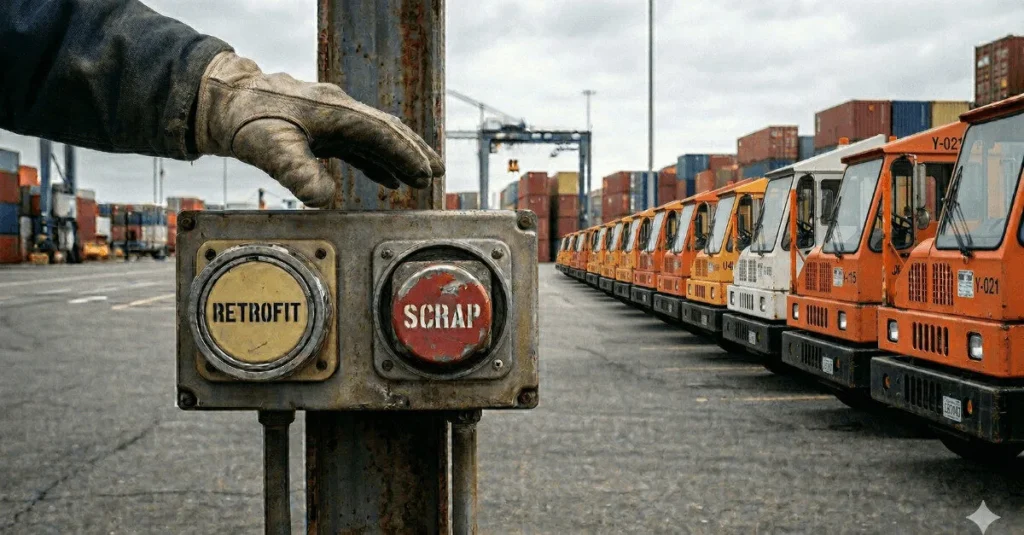
Despite these benefits, high upfront costs and lengthy “time-to-value” may deter operators from taking the autonomous path. Retrofitting existing tractor fleets with autonomy (rather than scrapping them for all-new ATTs) unlocks substantial and immediate value with lower capital requirements, accelerates ROI, and minimizes disruption to operations.
New-Build ATT vs. Retrofit: Two Paths to Autonomy
The New-Build Path:
This involves purchasing purpose-built autonomous and electric terminal tractors. These are clean-slate vehicles that come with a high price tag and significant up-front investment. Lead times can stretch 12 to 18 months.
 The Retrofit Path:
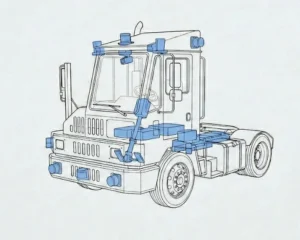
This involves installing an “autonomy kit” – sensors (LiDAR, radar, cameras), compute modules, Drive-by-Wire actuators, and autonomy software – onto an existing, in-operation terminal tractor. This approach preserves the existing investment in the vehicle while upgrading its capabilities, converting the terminal tractor into an autonomous vehicle.
The Value in Existing Fleets
Terminal’s current fleet represents substantial capital invested and institutional knowledge. Terminal tractors are built to last 15–20 years, and most ports already run mixed-age fleets. Scrapping a five-year-old tractor with a decade of service remaining is, for many operators, a financial non-starter.
Retrofitting separates the “intelligence” of the vehicle from the “chassis”, extending asset life while avoiding additional capital outlays. This flexibility makes autonomy adoption financially viable — and more scalable — for ports of any size.
Maintenance and Continuity
A critical benefit of going the retrofit path is the continuity of operations. The terminal’s mechanics already know how to fix the engines, hydraulics, and fifth wheels of the current fleets. Maintenance departments have a warehouse full of spare parts, and established relationships with local vendors. In selecting retrofit, only the autonomy layer is new. Operations teams don’t need to learn a completely new vehicle architecture; they simply need to learn how to maintain the sensor suite and calibrate the software.
Decoupling Autonomy from Electrification
Autonomy and electrification don’t have to happen together. Introducing electric vehicles requires significant planning and investment due to the impact on port layout, infrastructure and operational procedures.
Retrofitting lets port operators autonomize diesel fleets now, capturing immediate productivity and safety benefits, and handle the electric transition on its own separate timeline.
Sustainability Through Lifecycle Extension
Manufacturing a new heavy vehicle accounts for approximately 25% of its total lifetime carbon footprint. By retrofitting, you are effectively practicing “industrial upcycling.” Extending the life of a functional machine by 10 years prevents the massive energy expenditure required to smelt new steel and manufacture new components. As noted in recent circular economy studies, the greenest vehicle is often the one that has already been built.